
Episode 88 – From Reconstruction to DEI: The Long Arc of Race Relations in Texas
Podcast: Play in new window | Download | Embed
Episode 88 – From Reconstruction to DEI: The Long Arc of Race Relations in Texas
Hello folks, I’m Hank Wilson and welcome to Episode 88 of the Hidden History of Texas. This is Episode 88 – From Reconstruction to DEI: The Long Arc of Race Relations in Texas
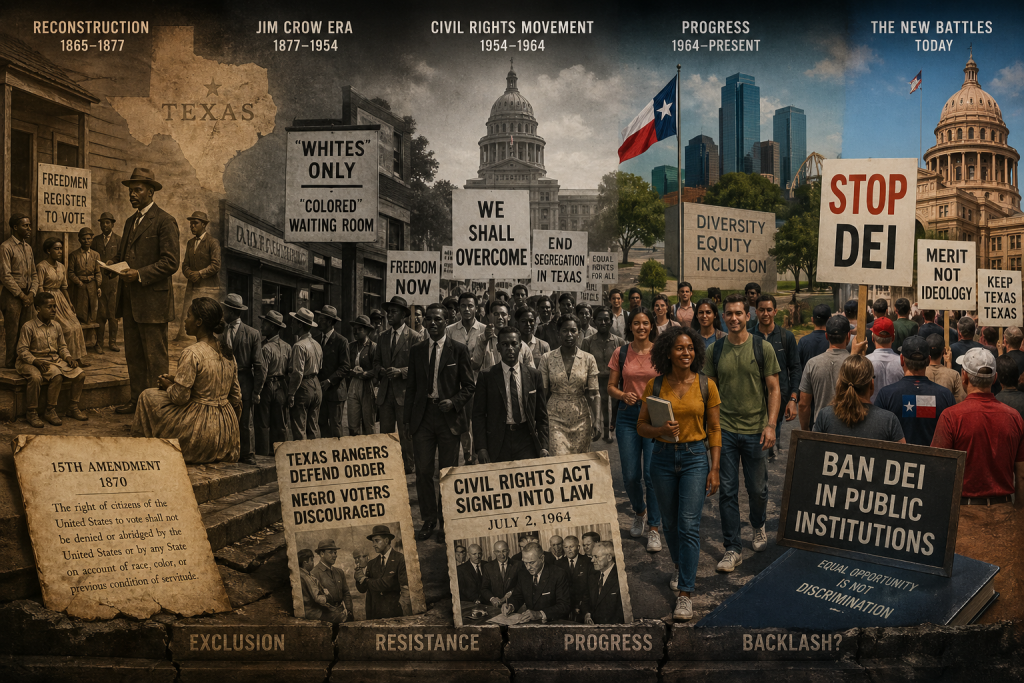
In this episode I’m going to talk about a subject that a lot of folks like to avoid. That is the subject of race and race relations in Texas History. The story of the struggle that both African Americans and Mexican Americans faced in achieving their civil rights might be something you were unaware of. While our image travels from reconstruction to today, and that is the title of this episode, the reality is also that our Mexican American citizens have fought to improve their political circumstances ever since the Anglos began showing up in the 1820s and especially after the revolution of 1836. The struggle African Americans faced started after their emancipation from slavery in 1865. For the most part though organized campaigns for both groups really weren’t launched until the early twentieth century.
In the years following the Texas Revolution Tejanos were often the focal point of Anglo hatred and mistrust. In the 1850s, Anglos accused Tejanos in Central Texas of helping slaves escape to Mexico and many of the Tejano families were forced to leave their homes. During the Cart War of 1857 (which I covered in a previous episode) Tejanos around Goliad and San Antonio were attacked by Anglos. Two years later in 1859, Tejano’s in South Texas were attacked after Juan N. Cortina’s captured Brownsville. And he issued a proclamation demanding the protection of Mexican-American land rights. Needless to say, this caused panic among Anglo residents who thought of him a nothing more than a bandit. This instigated the “First Cortina War” which grew in intensity and eventually required the U.S. Army, including troops under Robert E. Lee and local Texas Rangers, to eventually force him to retreat into Mexico by December 1859. It was called the First Cortina War because Cortina returned during the Civil War (hence, the Second Cortina War), initially assisting the Union army this time, (after all he recognized that the Confederacy wanted to maintain slavery and continue to take the land held by Tejanos) and he succeed in taking control of steamboats, before being defeated in 1861 by Confederate forces under Santos Benavides.
After the Civil War, both the newly freed slaves and Tejanos faced further atrocities. In the 1880s, White men in East Texas used lynching as their preferred method of maintaining political control. It became very common as a method of retaliation for alleged rapes of White women or for other insults or injuries that white people felt had been perpetrated. Mexican Americans of South Texas faced the same problems. The Ku Klux Klan, the White Caps, law officials, and the Texas Rangers, all served as official and unofficial enforcers of White authority, and they regularly terrorized both Mexican and Black Texans.
For blacks emancipation eventually proved to be more of a symbolic action than anything else, because while slaves were freed from official bondage, they were still mostly blocked from fully participating in society. Freedmen often found themselves barred from most public places and schools and often were forced to live only in certain residential areas of towns.
As the calendar changed to the twentieth century and reconstruction was abandoned, white politicians insured that such practices were written into the law. Even though Tejanos were not specifically targeted by these statutes they were still often subjected to them through unwritten social customs. Through the 1880s and 1890s, both African Americans and Mexican Americans faced organized legal efforts to disfranchise them and if those didn’t work, Anglos turned to a variety of informal means to weaken their political strength.
The most common method they faced were terrorist tactics, literacy tests, the stuffing of ballot boxes, and accusations of incompetence when they won office. White political bosses in South Texas and other areas with large Mexican-American population such as the El Paso or Rio Grande valley, meantime, dominated their areas by controlling the votes of the poor.
Two of the more odorous methods used by the white politicians was the poll-tax law and the other was the white primary passed by Texas Democrats. The poll tax law was passed in 1902 the legislature passed the poll-tax law which required every person who wanted to vote to “pay from $1.50 to $1.75’ for that privilege, which effectively disenfranchised those who were poor. (Poll Taxes for federal elections weren’t eliminated until 1964 when the 24th amendment was passed and then in 1966 for state election.)
These mechanisms disfranchised Blacks, and Mexican Americans for that matter, for White society did not regard Tejanos as belonging to the “White” race. Progressive reformers of the age viewed both minority groups as having a corrupting influence on politics. By the late 1920s, Texas politicians had effectively immobilized African-Texan voters through court cases that defined political parties as private organizations that could exclude members. Some scholars have estimated that no more than 40,000 of the estimated 160,000 eligible Black voters retained their franchise in the 1920s.
Racial animosity in Texas (and indeed throughout the south) was rampant. White controlled legislatures passed what are known as Jim Crow laws. These laws greatly increased the segregation of the races, and in the cities, Black migrants from the rural areas were shunted into ghettoes where black citizens were already relegated.
Ordinarily the Jim Crow laws did not target Mexicans but, there was an understanding among white people that the laws were to be enforced on the premise that Mexicans were an inferior people. This meant that Tejanos were, much like black Texans, relegated to separate residential areas or designated public facilities. While the Tejano population was primarily Catholic, remember Texas was originally settled through the use of Missions, they were often made to worship at segregated churches.
When it came to education both Blacks and Hispanics attended segregated and inferior “colored” and “Mexican” schools. In the mid-1950s, the state legislature passed segregationist laws directed at Blacks (and by implication to Tejanos), some dealing with education, others with residential areas and public accommodations. Texas governor R. Allan Shivers, who was opposed to integration especially in education and vehemently opposed the 1954 Brown v. Board of Education decision, went so far as to call out the Texas Rangers at Mansfield in 1956 to prevent Black students from entering the public school
His successor Marion Price Daniel, Sr., was a little more tolerant, the integration process in Texas was slow and painful. Supreme Court decisions in 1969 and 1971 ordered school districts to increase the number of Black students in White schools through the extremely controversial practice of busing.
As the 1960s started African Americans and Mexican Americans began to participate in both State and national movements that were designed to help bring down racial barriers. Black Texans held demonstrations within the state to protest the long lasting and well entrenched conditions created by segregation. Understanding the power of the dollar individuals began to boycott racist merchants. When the National March on Washington took place in 1963, approximately 900 protesters marched on the state Capitol in Austin. This was a very diverse group and included Hispanics, Blacks, and Whites, and they directly called out the slow pace of desegregation in the state and Governor John Connally’s opposition to the pending civil-rights bill in Washington. After the passing of the contentious Civil Rights act of 1964, more and more people, especially those people of color began to demand the equality promised in the Constitution.
By the latter half of the sixties, some segments of the Black community began to embrace the concept of “Black power” and a minority of them believed violence was the best avenue to achieve social redress. While throughout America riots did take place in major urban areas, the destruction of property and life in Texas in no way compared to that in other states. Likewise, Tejanos took part in the Chicano movement of the era, and some, especially youths, supported militancy, and denounced “gringos,” and spoke of voluntary separatism from American society. The Raza Unida party spearheaded the movement during the 1970s. A political party, Raza Unida offered solutions to inequalities previously addressed by reformist groups such as LULAC and the G.I. Forum. Members used demonstrations and boycotts and confrontational approaches, but violence of significant magnitude seldom materialized. The movement declined by the mid-1970s.
During the same period, the federal government tried to implement an agenda designed to achieve racial equality, and Texas Mexicans and Black Texans both profited from this initiative. The Twenty-fourth Amendment, ratified in 1964, barred the poll tax in federal elections. In 1969 Texas repealed its own separatist statutes. The federal Voting Rights Act of 1965 eliminated local restrictions to voting and required that federal marshals monitor election proceedings. Ten years later, another voting-rights act demanded modification or elimination of at-large elections.
Much of the activity in civil rights during the last quarter of the twentieth century and the opening decade of the new millennium focused on consolidating the gains of previous decades. For example, African Americans and Mexican Americans registered to vote in unprecedented numbers, and members of both ethnic groups won election to major local, state, and federal offices. Issues such as affirmative action in higher education remained, but the civil-rights movement permanently changed the social and political landscape of Texas.
Recently though Texas and other Southern states have seen efforts by politicians, particularly in the Republican party to roll back those gains. Through the use of creating voting districts that are predominantly white they try to insure only conservatives have a chance to win. In their political rhetoric they lament the passing of the ‘good old days’ and the dangers of immigrants. While they are not overly racist in the words, the messages they send are very clear and they harken back to the 1950s and even before.
It’s said that history repeats itself, and while the actual events don’t the patterns often do.
That’s going to do it for this episode, I’m hank Wilson and this is the Hidden History of Texas