
Episode 87 – The Towns the Company Owned
Podcast: Play in new window | Download | Embed
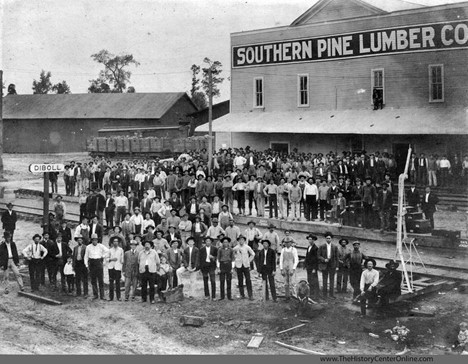
Episode 87 of the Hidden History of Texas – The Towns the Company Owned
There was a time in East Texas…when you could live your entire life…without ever leaving the reach of a single company.
They built your house. They paid your wages. They sold you your food. They taught your children…and sometimes… they buried your dead.
These were the company towns of East Texas places that don’t always show up in the history books…but helped build the state as we know it.
The Piney Woods System
Long before oil changed Texas…the wealth of East Texas came from the forest.
Endless stretches of longleaf pine straight, tall, and valuable.
But the forests weren’t near cities. They were deep in the Piney Woods…isolated… difficult… and expensive to reach.
So the lumber companies did something remarkable.
They didn’t just build mills. They built entire towns.
Places like Diboll, Manning, and Camden weren’t accidents of settlement they were designed systems.
Efficient. Controlled. Purpose-built.
A Life Inside the System
In these towns…you didn’t just work for the company.
You lived inside it.
Your house? Owned by the company.
Your groceries? Bought at the company store.
Your paycheck? Sometimes paid in cash…sometimes in scrip, currency only good inside that same system.
And if you stepped back and looked at it what you saw wasn’t just a town.
It was a closed loop.
A complete economic ecosystem…decades before anyone used words like “platform” or “vertical integration.”
Diboll: The Model Town
Take Diboll, for example.
Built around the Southern Pine Lumber Company, it became one of the most structured company towns in Texas.
Neighborhoods were organized. Workers were grouped, sometimes by job, sometimes by race. Life had a rhythm… defined by the mill whistle.
Diboll lasted longer than most. Not because the system changed…but because the company adapted just enough to survive.
Many others weren’t so fortunate.
When the Forest Was Gone
The thing about timber towns…is that they were built on something that could disappear. Tree by tree. Rail line by rail line.
And when the forest was gone…the reason for the town disappeared with it. Places like Manning faded quietly.
No dramatic collapse. No headlines. Just… empty houses. Silent tracks. And the slow return of the forest.
Then Came Oil
Then, in 1930, everything changed. The East Texas Oil Boom didn’t just create wealth, it created chaos.
Where timber towns were planned…oil towns exploded. Kilgore. Joinerville and dozens more.
Overnight, forests filled with derricks. Fields turned into tent cities, shacks were thrown up, and hurried streets.
The companies were still there, but control was looser. Faster. Rougher. Temporary. If timber towns were systems…oil towns were surges.
Control vs. Freedom
And that’s the contrast that defines this hidden chapter. Timber towns offered stability, but at the cost of control.
Oil towns offered opportunity but at the cost of order. Two different models of the same idea:
What happens when an entire community…is built around a single industry?
Closing
Today, if you drive through East Texas…you’ll pass through places like Diboll without thinking twice.
You might not notice what used to be there. The rows of company houses. The store where everyone shopped. The mill that set the rhythm of life.
But the pattern hasn’t disappeared. It’s just changed form.
Because the idea of a “company town”…never really went away. It evolved.
From the forests of the Piney Woods…to the oil fields beneath them…this is another chapter in the Hidden History of Texas.
But in reality, History isn’t over yet, because “The Company Town Never Left”
There’s a phrase we don’t use much anymore. “Company town.”
It sounds like something from another century; something tied to sawmills… rail lines… and oil derricks.
But if you look a little closer…the idea didn’t disappear.
It just changed form.
In those East Texas towns, the company controlled the essentials.
Where you lived. Where you worked. Where you shopped.
Your economic life…was contained within a single system.
And today?
We don’t always live in physical company towns…but many of us live in digital ones.
Think about it.
The platforms we depend on, for communication, business, even identity
They provide the marketplace. They set the rules. They take a percentage of every transaction.
And if you step outside that system…you often lose access to the very audience you built.
Now, Washington doesn’t call them company towns.
It calls them markets. Platforms. Ecosystems.
But the questions feel familiar.
How much control is too much? What happens when one system becomes unavoidable?
And who really owns the value created inside it?
In East Texas, when the timber ran out…the towns disappeared.
When oil slowed down…people moved on.
But today’s systems aren’t tied to a forest…or a field.
They’re tied to infrastructure…policy…and increasingly… data.
And that’s what makes this moment different.
Because for the first time, the “company town” isn’t in one place.
It’s everywhere.
Something to think about…as we look at where we’ve been, and where we might be going.
This is the Hidden History of Texas