
When the South Was Blue: A Forgotten Political World
Podcast (https-arctx-org-feed-realignment): Play in new window | Download | Embed
When the South Was Blue: A Forgotten Political World
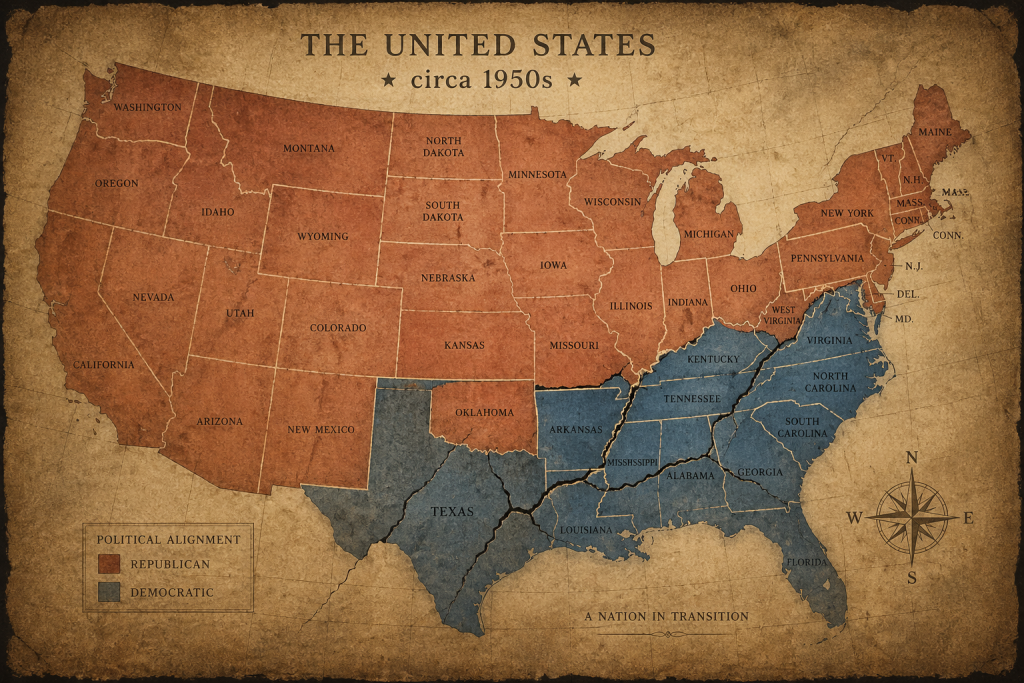
If you’re of a certain age group you might remember when there was a time, not all that long ago, when Texas was Democratic.
Not only was Texas democratic, so was the entire South. By democratic, I mean Texas and the entire south was controlled by the democratic party.
From the pine forests of East Texas to the courthouse squares of Alabama, the Democratic Party wasn’t just popular, it dominated. For generations, it was simply understood: if you lived in the South, you voted Democrat.
And Republicans?
They were something else entirely. They were seen as a party of the North, remember Reconstruction. They were a business party. Some called them a “country club” party. Strong in places like New York, Pennsylvania, and Illinois, but largely absent from the political life of the South.
Many people today find that hard to imagine.
Because today, Texas is one of the strongest Republican states in the country. So are most of its Southern neighbors. The political map looks clean, almost inevitable, red across the South, blue along the coasts.
But it wasn’t inevitable.
It was built.
A Political World Turned Upside Down
To understand how we got here, we have to step back into a different America.
In the early 20th century, the Democratic Party was a strange coalition. It brought together Northern urban immigrants, labor unions, and, critically, white Southern voters who had remained loyal to the party since the aftermath of the Civil War.
That loyalty wasn’t about ideology in the modern sense. It was about history, identity, and power.
Meanwhile, the Republican Party still carried the legacy of Abraham Lincoln and the Union. In much of the South, that alone made it politically toxic for decades.
So, the lines were drawn:
- Democrats ruled the South
- Republicans dominated parts of the North and Midwest
Two parties. But not the same two parties we recognize today.
Cracks Begin to Form
By the mid-20th century, however, something began to shift.
The country was changing, economically, culturally, and demographically. World War II had reshaped the nation. Cities were growing. New voices were demanding to be heard.
And then came a Supreme Court decision that would send shockwaves across the South:
Brown v. Board of Education
In 1954, the Court ruled that segregated public schools were unconstitutional.
On paper, it was a legal decision.
In reality, it was a political earthquake.
The Beginning of a Long Reaction
Across the South, including Texas, the reaction was immediate and intense.
State governments resisted. Local leaders pushed back. Communities divided.
But something else was happening beneath the surface, something quieter, but ultimately more consequential.
Voters began to reconsider their political loyalties.
Not all at once. Not in a straight line. But the first cracks had formed in what had once seemed like an unbreakable political order.
A Question That Still Echoes
If the Democratic Party had long been the party of the South…
and the Republican Party had long been something else entirely…
Then how did we end up where we are today?
How did Texas go from blue to red?
How did the South realign itself so completely that it now anchors modern Republican power?
And perhaps the most important question:
Was this transformation inevitable, or was it the result of a series of choices, reactions, and turning points that we can still trace today?
Where We Go Next
In the next article, i’ll move forward into the 1960s, a decade where those early cracks widened into something much larger.
We’ll look at a single year that many historians consider a breaking point:
A new law. A new political reality. And the beginning of a shift that would reshape American politics for generations.
If you’d like to follow along, subscribe below. This is a story that didn’t happen overnight—and it didn’t end in the 1960s.
In many ways, we’re still living it.
“In the next piece, we’ll move into 1964… where things really begin to shift.”