
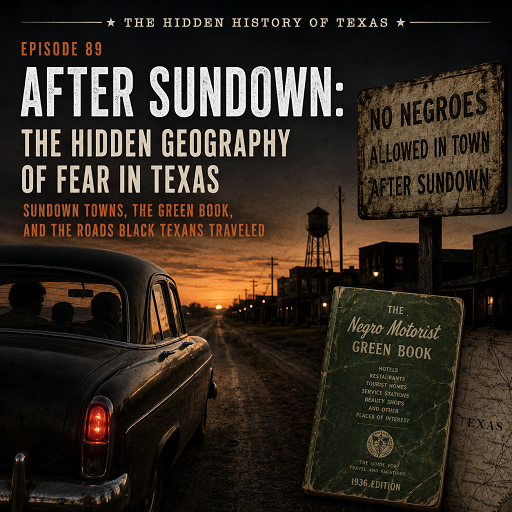
Episode 89 After Sundown: The Hidden Geography of Fear in Texas
Podcast: Play in new window | Download | Embed
Welcome to Episode 89 of The Hidden History of Texas. After Sundown: The Hidden Geography of Fear in Texas
Tonight, we’re stepping onto a highway most history books barely mention.
A road traveled in silence…
A road traveled with caution…
And sometimes, a road traveled in fear.
This episode is called:
“After Sundown: The Hidden Geography of Fear in Texas.”
We’re going to talk about Sundown Towns…
The Green Book…
And the hidden map Black Texans and Black travelers carried in their minds during the Jim Crow era.
Now imagine this with me.
The year is 1952.
You’ve just crossed the Sabine River leaving Louisiana and entering Texas.
The sun is beginning to sink low across the horizon. Your children are asleep in the back seat. Your gas gauge is dropping toward empty.
And suddenly… you’re nervous.
Not because of bandits.
Not because of weather.
Not because of the road itself.
You’re afraid of where you might accidentally stop.
Because there are towns ahead where being Black after dark could get you threatened… beaten… arrested… or worse.
So before you ever left home, you packed something almost as important as gasoline.
A small green book.
Texas has always carried a larger-than-life image in the American imagination.
Cowboys.
Oil wells.
Cattle drives.
Wide-open skies.
Frontier independence.
But hidden beneath that mythology is another Texas.
A Texas many people never experienced firsthand…
and many others could never escape.
For decades, scattered across this state and across America, were places known as Sundown Towns.
Some had signs posted right at the city limits.
Others didn’t need signs at all.
Everybody knew the rules.
“Don’t let the sun set on you here.”
Now before we go further, let’s talk about that little green book.
The Negro Motorist Green Book was first published in 1936 by a Harlem postal worker named Victor H. Green.
At first, it covered only New York City.
But over time, it expanded across the United States, Canada, Mexico, and even Bermuda.
Inside were lists of hotels, restaurants, tourist homes, gas stations, barber shops, beauty parlors, and businesses where Black travelers were welcome or at least safe.
Safe.
Think about that word.
Today, most Americans choose a hotel based on price or reviews.
Back then, Black families often chose places based on one simple question:
“Will we survive the night?”
The Green Book became known as “the bible of Black travel.”
And it wasn’t paranoia.
It was necessity.
Because across America, including Texas, there were towns where Black travelers knew not to stop after dark.
So what exactly was a Sundown Town?
A Sundown Town was a community that either formally or informally excluded minorities from remaining there after sunset.
Most commonly, these policies targeted African Americans.
But in some places, the hostility extended to Mexican Americans, Chinese Americans, Native Americans, Jews, Catholics, Mormons, almost anyone considered “outside” the community’s idea of whiteness.
Some towns passed ordinances.
Others used intimidation.
Violence.
Threats.
Economic pressure.
Police harassment.
And often, unwritten rules enforced the system more effectively than laws ever could.
Maybe businesses mysteriously closed at sunset.
Maybe hotels “had no vacancies.”
Maybe gas stations refused service.
Maybe local law enforcement simply escorted Black travelers to the city limits.
The message was always understood.
“You don’t belong here.”
Now many people think this was mostly a Deep South phenomenon.
But Texas had its own long and painful history with Sundown Towns.
Some communities openly embraced exclusion.
Others quietly practiced it for generations.
And some of those legacies still linger today.
Take Alba.
Small East Texas town.
Population under five hundred.
On the surface, it looks peaceful.
But historically, Alba was founded as an all-white community.
In the year 2000, it was still reported to be over 98 percent white.
One local theory even claimed the town’s name came from the Latin word for “white.” (note: the Latin word is album)
Whether that story is fully true or not almost doesn’t matter.
Because the reputation itself tells us something important about how communities wanted to define themselves.
Then there’s Alvin.
In 1933, a brutal axe murder shocked the community.
When suspicion briefly turned toward a Black suspect, local newspapers reportedly noted that this seemed unlikely because “practically no negroes are allowed to live in Alvin.”
Imagine reading that sentence in a newspaper today.
Not whispered privately.
Printed openly.
As if exclusion itself were ordinary.
Because at the time, in many places, it was.
And perhaps one of the starkest examples comes from De Leon in Comanche County.
In the late 1800s, Black residents were driven out after racial violence and lynchings.
According to historical accounts, signs reportedly warned Black people not to let the sun set on them in town.
And over time, the absence of Black residents became normalized.
One Black resident interviewed decades later described growing up isolated… excluded from parties… unable to find anyone who understood her experience.
That’s one of the hidden costs of segregation people often forget.
Not just physical danger.
Isolation.
Loneliness.
The quiet message that you are permanently outside the community around you.
But history is complicated.
And not every Texas town stayed frozen in that past.
Consider Killeen.
In 1950, Killeen reportedly had no Black residents.
But the growth of nearby Fort Hood, now known as Fort Cavazos and now back to Fort Hood, slowly changed the city’s demographics.
Black soldiers stationed there challenged old barriers simply by existing in large numbers.
And by the 1960s, those barriers began to crack.
Today, Killeen is one of the most diverse cities in Texas.
That transformation reminds us something important:
History is not destiny.
Communities can change.
But only when people are willing to confront the truth about where they’ve been.
And then there’s perhaps the most infamous modern example in Texas:
Vidor.
For decades, Vidor became nationally known for Ku Klux Klan activity and racial intimidation.
Cross burnings.
Marches.
Threats.
Even in the 1990s, not the 1890s but the 1990s, Black families moving into public housing faced bomb threats and harassment so severe some fled for their safety.
Now it’s important to say this carefully.
A town is not permanently defined by its worst history.
And many residents today reject those beliefs entirely.
But understanding that this happened within living memory matters.
Because sometimes Americans talk about segregation and racial terror as though it belongs to some ancient, distant era.
It doesn’t.
Some of this history is only a generation or two behind us.
Now there’s another piece of this story we have to understand.
The Green Book wasn’t just about avoiding danger.
It was also about building community.
Inside its pages were Black-owned businesses…
restaurants…
tourist homes…
beauty shops…
service stations.
It represented an entire parallel economy created because segregation left Black Americans excluded from so much of mainstream society.
And in many ways, those businesses became lifelines.
Places where travelers could finally exhale.
Places where they didn’t have to wonder whether they’d be humiliated… denied service… or attacked.
The Green Book stopped publication in 1966, two years after the Civil Rights Act outlawed segregation in public accommodations.
Legally, the world had changed.
But culturally…
well, culture often changes slower than laws.
And some roads remained dangerous long after the signs came down.
One of the challenges of studying this history is that many Sundown Towns never officially documented their policies.
No ordinance.
No paperwork.
No public declaration.
Just memory.
Warnings passed from parent to child.
Stories told quietly at kitchen tables.
“Don’t stop there.”
“Keep driving.”
“Make sure you have enough gas.”
That hidden geography shaped how people traveled through Texas for generations.
And unless you experienced it yourself, you may never have realized it existed.
History often remembers the grand moments.
The battles.
The presidents.
The famous speeches.
But sometimes the most revealing truths are found in ordinary things.
Like a family trying to find a motel before dark.
Or a child asking why they can’t stop in a certain town.
Or a worn little green book folded into a glove compartment.
Those quiet details tell us just as much about America as monuments and battlefields ever could.
And maybe that’s the real purpose of hidden history.
Not to make people ashamed of the past.
But to understand it honestly.
Because history that remains buried has a strange way of repeating itself.
But history that is remembered…
examined…
and understood…
can become something else entirely.
A warning.
A lesson.
And hopefully… a path forward.
I’m Hank Wilson, and this has been Episode 89 of The Hidden History of Texas.
Until next time…
keep asking questions…
keep digging deeper…
and never stop looking beneath the surface of the stories we think we already know.